|
|
|
|
|
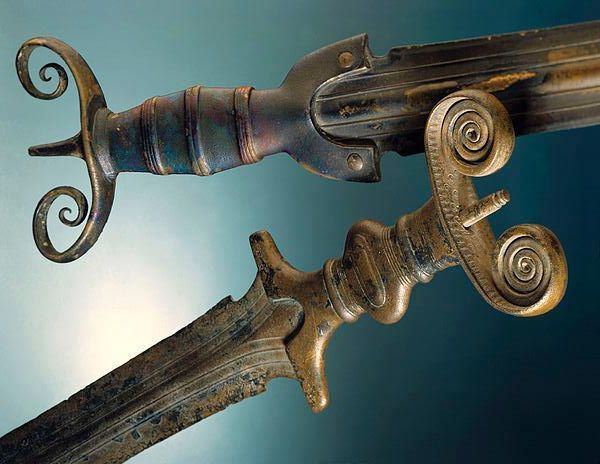
Celtic Spirals |
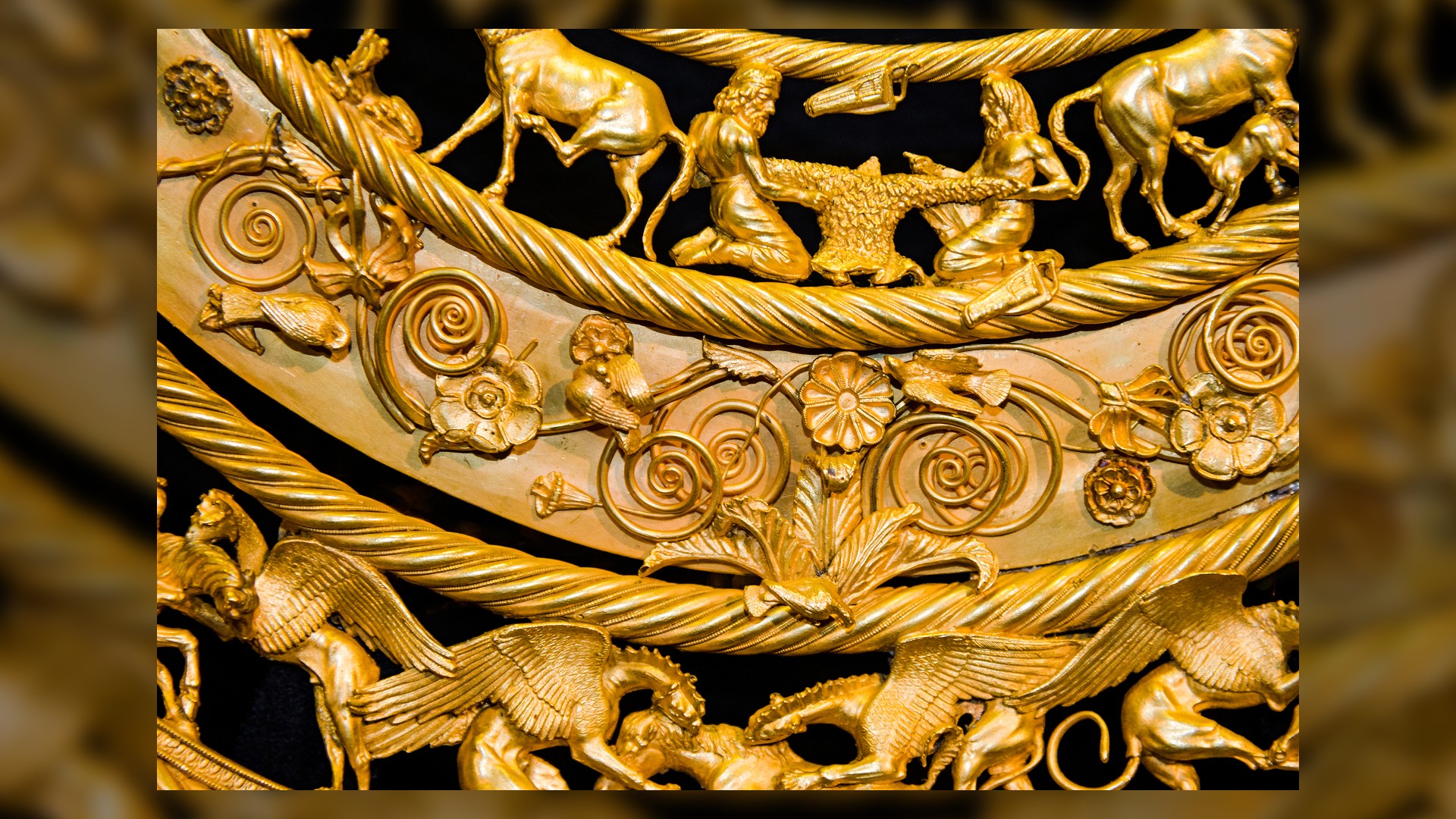
Scythian Spirals |
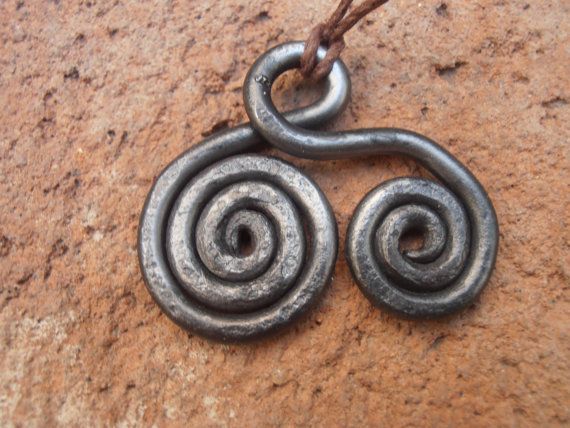
Viking Spirals |
Hope of Israel Ministries (Ecclesia of YEHOVAH):
The Peoples of Today's Israel Identified by Archaeology
|
When Assyria was conquered by the Babylonians, the gentilized Israelites moved out, to become "wanderers amongst the nations," as the prophets foretold. It was by "wandering" peoples, Scythians and Celts, that Britain was first colonized. This Israelitish origin of the English-speaking peoples is seen in the affinities between the arts and skills of ancient Egypt, the ancient Greeks, the Etruscans, the Scythians and, subsequently, the Celts, Anglo-Saxons, and the kindred folk who now constitute the great family of nations of western Christendom -- modern Israel, |
by W.F. Finlayson
The well-founded case for Celto-Saxon identity with the true Israel is based firmly upon the Word of YEHOVAH God -- and particularly upon the unconditional promises made by Almighty God to the Fathers of Israel; to Abraham, Isaac, and Jacob, concerning their descendants in these Latter Days of the Christian dispensation. This basic theme is completed in countless prophecies, confirmed by the Messiah, throughout the Scriptures. Indeed, no other basis is required for this tremendous Israel Truth.
There is, of course, abundant evidence from other Scriptural sources and from secular evidence which support and confirm that the English-speaking and kindred peoples are descended from YEHOVAH God's Servant People -- Israel of old.
Many historians, from the 8th-century English scholar the Venerable Bede to the nineteenth century, were interested in the origins of our Celto-Saxon peoples. Their conclusions confirm that the tribes and clans who colonized the British Isles -- Scripture's "Isles of the West" -- came from the lands where the gentilized Israelites sojourned during their journeyings to YEHOVAH's "Appointed Place." Twentieth century historians, however, are strangely lacking in any interest concerning the origins of these related peoples -- being content to commence their histories with their arrival in Britain. Presumably, according to them, they could not possibly have any worthwhile history prior to this.
There is absolutely no excuse for this unpardonable omission, particularly in view of the positive knowledge that the archaeologist is continually disproving the hoary myth that the first arrivals -- the ancient Britons -- were simple savages "until the Romans civilized them." This grievous error surely dies hard.
One example of the many works by modem scholars whose studies lend support to our case (although they themselves are not in any way allied to our beliefs) is Early Mediterranean Migrations by T. Burton-Brown; published in 1959 by the University of Manchester. In his position as Assistant Keeper at the Manchester Museum, this scholar studied a collection of pottery, discovered in Kahun in Lower Egypt, by Sir Flinders Petrie and now housed in the Museum. In his studies he discerned clear affinities with the art and skills of peoples whom we know to be of Israelite descent, including the Celts and Saxons who first colonized the British Isles.
Israelite Pottery
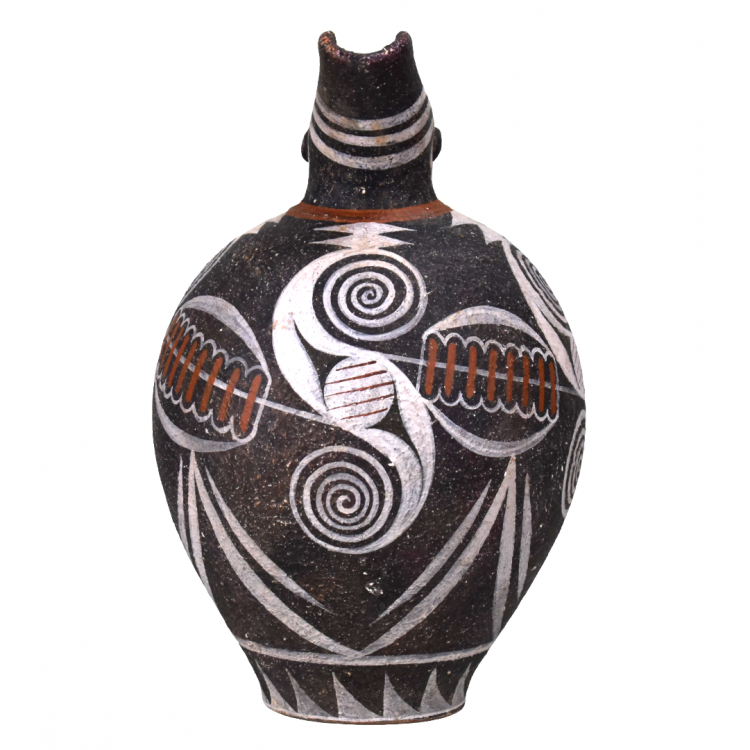
When British archaeologist Sir Flinders Petrie unearthed the village of Kahun (consisting of 2,000 separate dwellings dispersed over 18 acres and built to house the Israelites who were erecting the tomb of Sesostris II), he discovered some beautifully crafted pieces of pottery. "These sherds turned out to be 'Kamares Ware', a distinctive type of painted vase named after the cave sanctuary on Mount Ida in central Crete where they were first found. Similar vases also emerged in Sir Arthur Evan's 'First Palace Level' at Knossos [on Crete]...." (Discovering the World of the Ancient Greeks, by Zofia Archibald. Facts-On-File, N.Y. 1991, p. 64).
A number of facts should be
highlighted here: This pottery, discovered by Petrie, was used by the Israelites
erecting the pharaoh's pyramid; and the town built to house the workers was
called "Kahun" -- a Hebrew word derived from Kohan meaning "priest"!
Since this pottery has not been found amongst the general necropolis of the
Egyptians, it must have been manufactured by the Israelites themselves!
As well as at Kahun, Kamares pottery has been excavated from Illahun
(another Hebrew name) and Abydos in Egypt.
One of the things that struck the archaeologists was the beauty and
exquisiteness of this pottery; it is of superb craftsmanship, and only in later
Venetian glass, according to the experts, can equal feeling in color effects be
found. "It is said that the potters who produced this fine work admired the
sheen which the workers in bronze had managed to attain and had finally
succeeded in achieving it in their own 'eggshell' pottery" (The House of the
Double Axe: The Palace of Knossos, by Agnes Carr Vaughan. Doubleday & Co.,
N.Y. 1959, pp. 139-140).
A characteristic of this style of pottery is the spiral motif (found
delicately incorporated into the design) which is a
notable feature of pottery from Mycenae, Etruria, and other sites that were
inhabited by the Celtic tribes.
On page 69 we read:
"At the time: of the Mediterranean Middle Bronze Age (2000-600 B.C.) certain distinctive elements appeared in ceramics made within the Aegean World. They consist of a group of motifs, and an ornamental principle. The motifs are:
1/. The Spiral Pattern.
2/. The drawing of a human face, shown full and without body of limbs.
3/. A line which swells and contracts in thickness along its length.
4/. An object of a more or less pear-shaped form.
5/. The Palmette.
6/. A large roundel, within which motifs may be arranged."The ornamental principle is that of asymmetry. This is to be seen principally in the light-on-dark ornamental ceramics. All these things occur in the decoration of such objects as pottery vessels, metal objects, and carvings in stone produced by Celtic people of La Tene days and later and at the time when the Saxons were flourishing in central and western Europe. They seem to have been so commonly used in those days as to appear characteristically Celtic. Like Celtic speakers themselves they began to make their appearance at that epoch at about 400 B.C. Some were then very widespread, such as the curious idea of using part only of an entity (like the head alone, for example) which, while comparatively rare in Celtic art, is commonly found in the Mediterranean area and is well known in Scythian work.
"Perhaps the most important elements appear in the principle of asymmetry and in the drawings of a line which varies in its thickness imparting great vitality and liveliness to the design. Of the former, perhaps, the finest examples are the engraved mirrors found in England, such as the Desborough mirror in the British Museum. Of the latter, probably the best illustration is provided by the Torrs Chamfrein in the Royal Scottish Museum.
"The parallels drawn suggest that a particular group of artistic conventions was in use at two epochs very widely separated in time. It is surely fair to say that these conventions reveal an excellent sense of decoration, something not far, perhaps, from genius. Was this the mark of a particular people?"
|
|
|
|
|
Celtic Spirals |
Scythian Spirals |
Viking Spirals |
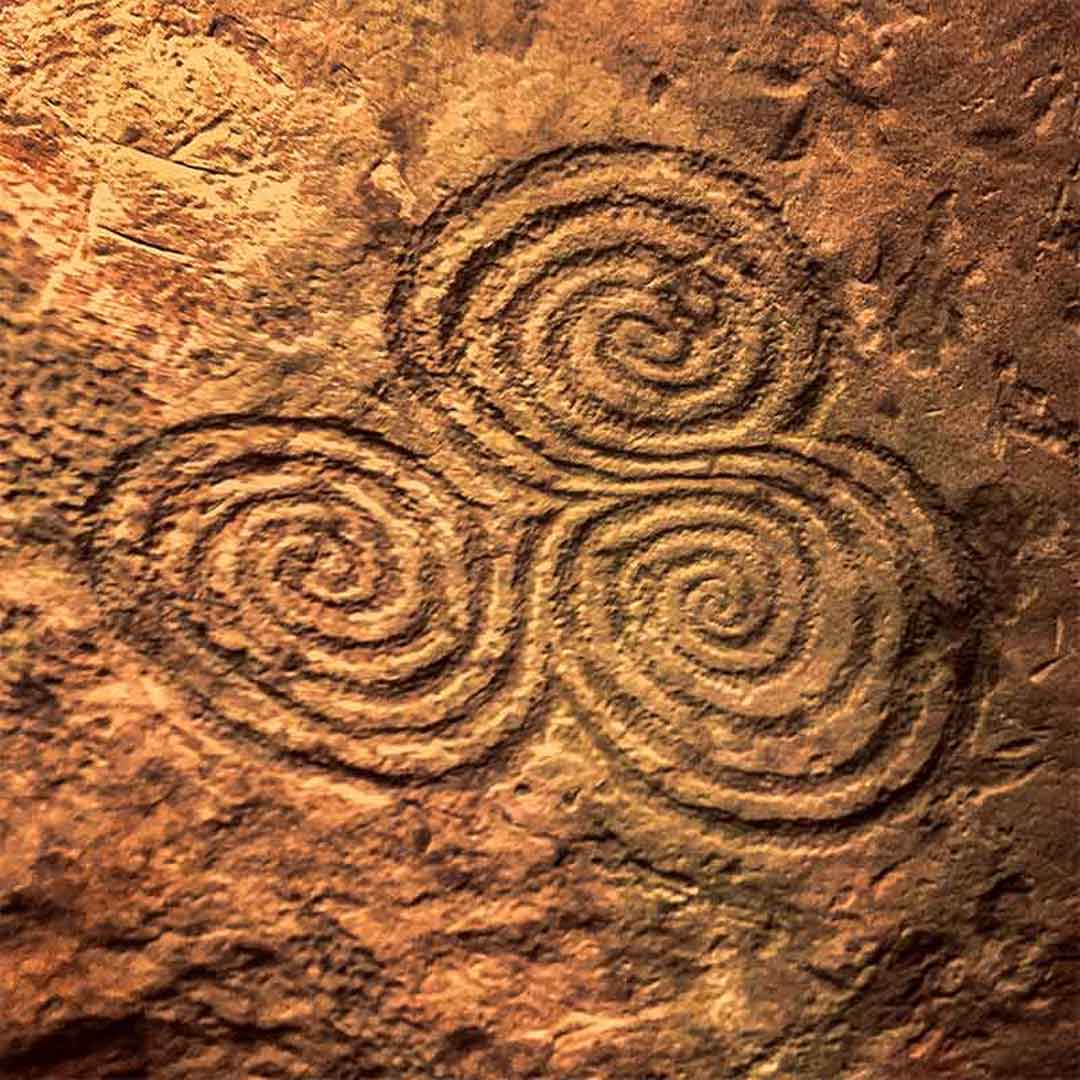
Spirals remain a powerful and enduring symbol in Ireland today. Their presence spans from prehistoric megaliths to modern design, reflecting a deep-rooted connection to Irish identity.
|
|
|
Newgrange Passage Tomb in Ireland |
Experts in Gold
On page 68, we read:
"The various types of gold jewelry made at about 2000 B.C. in Egypt and elsewhere in the eastern Mediterranean belong to categories of which examples appear at other times and in other places. For example, gold jewels covered all over by contiguous cloisons containing variously colored pieces of stone are typical of certain Teutonic' invaders of Europe early in the First Millennium A.D., the best known examples of whom are the Saxons of South-Eastern England.
"The same people made use of the technique of gold granulation, a peculiar technique utilized by the classical Greeks and widely by the Etruscans, a people supposed to have originated in Anatolia, or perhaps Caucasia. There is a remarkable link between the Saxons and the Etruscans provided by the fact that not only did both manufacture gold jewelry with similar techniques but also both adorned their plain polished grey pots with the impressions of engraved seals while the clay was still soft."
We must, of course, intervene here for as far as we are concerned who believe in the positive identity of Celto-Saxondom with Israel of old, Mr. Burton-Brown has -- in asking this remarkable question -- hit the nail on the head, These are indeed the mark of a particular people -- or, as the Apostle Peter terms them in our Authorized Version -- a "peculiar" people. These artistic conventions are the mark of the God-blessed sons of Shem which were inherited by the children of Eber (the Hebrews) and later by their progeny, the Israelites.
The. author continues:
"It is suggested by what has been said that one can trace parallels between early Second Millennium pottery in the Aegean area and the decorated products of people such as the La Tene Celts and the Saxons who were active in western Europe during the latter part of the first Millennium A.D. At that period, when the Celts and Saxons were active, there were several different artistic systems in use, overlapping to some extent, as for example in the case of the typically Celtic curvilinear system of decoration, which continued for a long time well into post-Christian times, and long after the Saxons had introduced new manners of ornament to the west.
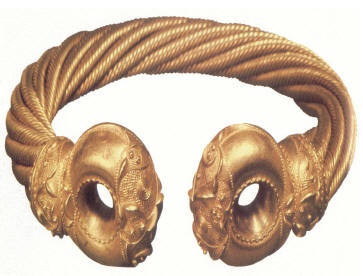
Torcs -- Israelite Neck Rings
Continues T. Burton-Brown:
"If such parallels are not due to chance they are hardly likely to be represented only by objects from the Aegean area at the time of the Second Millennium B.C. One might expect to find parallels also in Egypt. Such parallels do as a matter of fact occur. For not only does curvilinear decoration appear in Egypt on the light-on-dark decorated pots at Kahun, Abydos and other sites, not all of which by any means came from Crete or the Aegean, but also torques [torcs] have been found in deposits of the period of the Middle Kingdom in Egypt. Torques [torcs] are, in historic times, characteristic of only one people -- the Celts, The longevity of the Celtic dialects might well be thought to suggest the reality of a highly developed use of nationality which perhaps needed long to develop."
A torc, also spelled torq or torque, is a large rigid or stiff neck ring in metal, made either as a single piece or from strands twisted together. The great majority are open at the front, although some have hook and ring closures, and a few have mortice and tenon locking catches to close them. Many seemed designed for near-permanent wear and would have been difficult to remove.
|
|
|
A Celtic Torc |
High-ranking Druids, revered for their mystical knowledge and role in Celtic spiritual life, wore torcs to signify their elevated status. These spiritual leaders officiated rituals, interpreted omens, and guided their communities, and the torc visually represented their authority, wisdom, and connection to the divine. The intricate designs of torcs, sometimes incorporating symbolic patterns of the natural world, reinforced the Druid’s role as an intermediary between the mortal and spiritual realms.
Torcs have been found in Scythian, Illyrian, Thracian, Celtic, and other cultures of the European Iron Age from around the 8th century B.C. to the 3rd century A.D. For Iron Age Celts, the gold torc seems to have been a key object, it identified the wearer as a person of high rank. Torcs were also worn by chieftains, priests, elite warriors, noblewomen, and even high-status artisans, reflecting a broader cultural practice of using torcs to denote prestige and power. The Roman writer Cassius Dio describes Boudicca, queen of the Iceni in Britain, as wearing a twisted gold torc into battle against the Romans.
Many of the finest works of ancient Celtic art are torcs. During the Viking Age torc-style metal necklaces -- mainly in silver -- were popular.
The Flourishing of Other Arts
Mr. Burton-Brown also notes that in the Second Millennium B.C. there was a flourishing of other arts in Egypt, in styles completely different from the traditional and due, he suggests, to this "particular people" who had entered Egypt. There is the appearance of a non-traditional literature delighting in saga-like stories featuring the exploits of heroes in foreign lands which, flourishing later in Ancient Greece, brought immortality to Homer and flourished yet again in the Dark Ages in Scandinavia. There is the appearance of non-traditional sculptures which are far more imaginative and of greater artistic quality, revealing a deeper insight into the spiritual aspect of humanity,
This development -- which was short-lived in Egypt -- again is found to flourish later amongst the Ancient Greeks. In architecture, there was a sudden flourishing of non-traditional designs -- such as the fluted columns and which were later brought to fruition in the glorious architecture of Ancient Greece. Another interesting observation made by the author concerning an Egyptian dish with incised Semitic letters which could be paralleled in early Greek alphabets.
To summarize and conclude: Mr. T. Burton-Brown discerned unique arts and skills developed in Egypt in the Second Millennium B.C. which he attributes to a non-Egyptian people who had entered Egypt. He recognizes the same arts and skills amongst the ancient Greeks, the Etruscans, the Scythians and finally the Celts and the Anglo-Saxons.
We Are Descended from Israel!
His findings, assuredly, lend support, albeit unwittingly, to our belief that the British and kindred peoples are descended from Israel. It is incontestable that Jacob and his sons entered Egypt early in the Second Millennium B.C. Within 500 years they grew into a great nation envied and feared by the Pharaoh who "knew not Joseph." We need not stretch our imaginations very far to appreciate that the Israelites, cradled in the great center of civilization, would apply themselves to the arts and skills practiced in Egypt and would create that which was unique to them.
|
|
|
Kamares Pottery With Spirals |
Their skills were later to be applied to the construction of the Tabernacle, under Divine guidance. There is evidence to the effect that a contingent of Danites left Egypt before the general Exodus from Egypt and colonized Greece, helping to create the "Glory that was Greece." First-century Greek historian Diodorus Siculus writes:
"in Egypt there were formerly multitudes of strangers who used foreign rites and ceremonies in worshipping the gods, for which they were expelled from Egypt and, under Danaus, Cadmus, and other skillful commanders, came into Greece and other places. But the greater part came into Judea being conducted there by Moses a wise and valiant man."
The "greater part" became the nation of Israel in Canaan where they ultimately backslid from YEHOVAH God and separated into two separate and distinct nations -- Israel and Judah. The former, Israel, consisting of the ten northern tribes, separated themselves from the Throne of David and from Temple worship and the people became more and more like the Gentiles around them. In 721 B.C. they were conquered by the Assyrian Empire and transplanted into other parts of that Empire, where they became "Gentiles" as the prophets foretold.
When Assyria was conquered by the Babylonians, the gentilized Israelites moved out, to become "wanderers amongst the nations," as the prophets also foretold. It was by "wandering" peoples, Scythians and Celts, that Britain was first colonized. Historian Sharon Turner traced the Anglo-Saxons to the Scythians. Assuredly this Israelitish origin of the English-speaking peoples, which puzzled Mr. Burton-Brown, is seen in the affinities between the arts and skills of Ancient Egypt, the Ancient Greeks, the Etruscans, the Scythians and, subsequently, the Celts, Anglo-Saxons, and the kindred folk who now constitute the great family of nations of western Christendom -- modern Israel,
-- Edited by John D. Keyser.
|
Hope of Israel Ministries -- Paving the Way for the Return of YEHOVAH God and His Messiah! |
|
Hope of
Israel Ministries |
|
Scan with your Smartphone for more information |